How to Set Realistic SMART Goals with ADHD
How to Set Realistic SMART Goals with ADHD
Setting goals when you have ADHD can feel overwhelming, but tweaking the SMART framework - Specific, Measurable, Achievable, Relevant, Time-bound - can make it work for your brain. By breaking tasks into smaller steps, using visual tools, and focusing on short-term wins, you can stay motivated and on track. Here's the key:
- Specific: Break goals into small, actionable steps to avoid overwhelm.
- Measurable: Use trackers or apps to see progress clearly.
- Achievable: Focus on micro-goals to build confidence.
- Relevant: Connect goals to what excites or matters to you.
- Time-bound: Use short-term deadlines and timers to manage time blindness.
Tools like Focusmo help by offering timers, reminders, and progress tracking tailored for ADHD. Regularly review and adjust your goals to align with your energy and priorities. The key is progress, not perfection.
How to set SMART Goals with #ADHD
How to Adjust the SMART Framework for ADHD
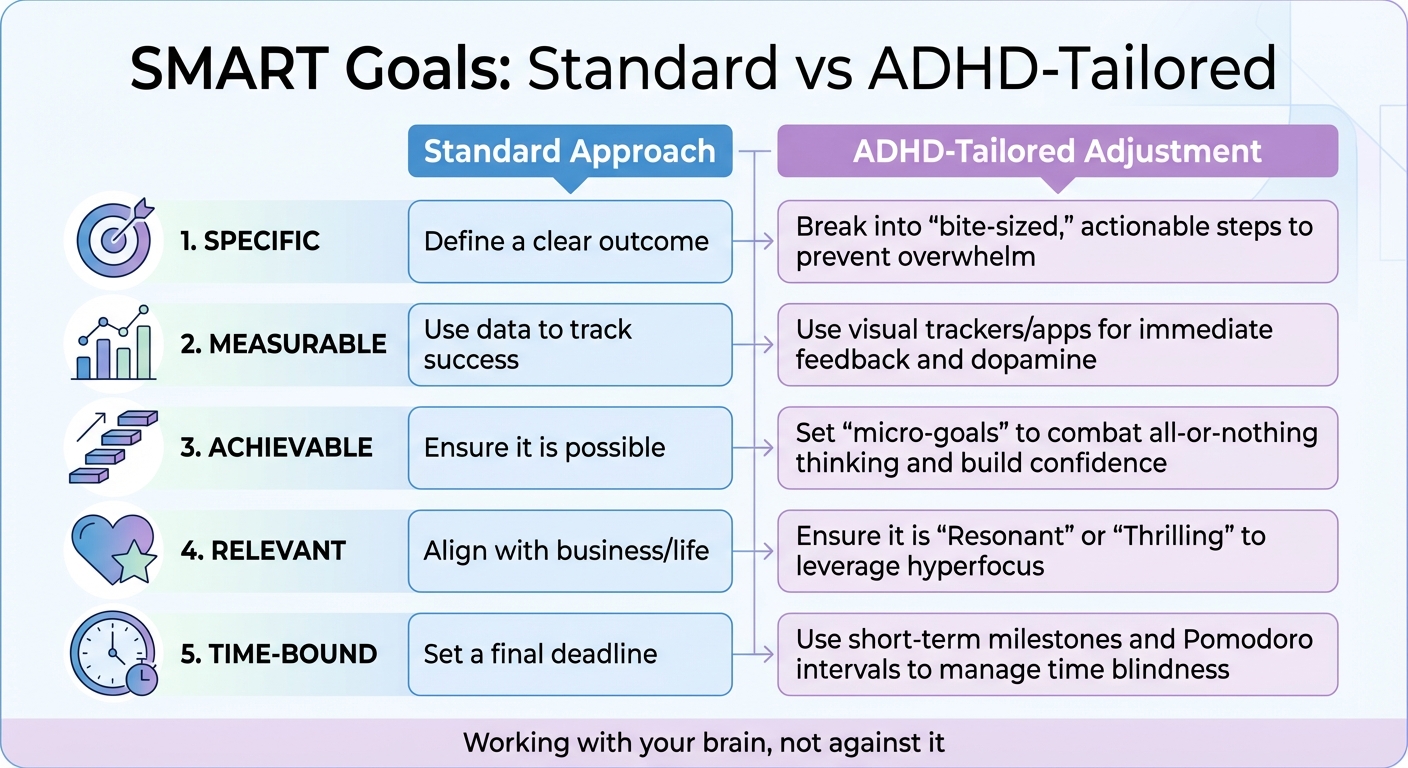
SMART Goals Framework: Standard vs ADHD-Tailored Approach
The traditional SMART framework can be tweaked to better suit the way ADHD brains function. Each component - Specific, Measurable, Achievable, Relevant, and Time-bound - can be adapted to address challenges like time blindness, working memory limitations, and the need for immediate rewards. These adjustments provide the structure and feedback that ADHD brains often thrive on. Here's a breakdown of how each element can be tailored:
| SMART Component | Standard Approach | ADHD-Tailored Adjustment |
|---|---|---|
| Specific | Define a clear outcome. | Break into "bite-sized", actionable steps to prevent overwhelm. |
| Measurable | Use data to track success. | Use visual trackers/apps for immediate feedback and dopamine. |
| Achievable | Ensure it is possible. | Set "micro-goals" to combat all-or-nothing thinking and build confidence. |
| Relevant | Align with business/life. | Ensure it is "Resonant" or "Thrilling" to leverage hyperfocus. |
| Time-bound | Set a final deadline. | Use short-term milestones and Pomodoro intervals to manage time blindness. |
These tweaks transform SMART goals into a more flexible and ADHD-friendly framework, working with your brain rather than against it. Below is a deeper dive into how to tailor each component.
Make Goals Specific and Clear
Clarity is essential. Without it, starting a task can feel overwhelming, often leading to procrastination. Specific goals eliminate ambiguity, giving you a clear target and reducing distractions.
"ADHD minds often struggle with vague or overly broad objectives. By making goals specific, we create a clear target to focus on, reducing the likelihood of becoming overwhelmed or distracted." – NeuroLaunch Editorial Team
Define the who, what, and how for every goal. Instead of a vague aim like "be more productive", try something actionable, such as "complete three high-priority tasks before checking email". Breaking tasks into small, manageable pieces - the "Swiss cheese" method - can also help. For example, tackle 5-minute subtasks or immediately complete any task that takes under two minutes to avoid a backlog.
Make Sure Goals Are Measurable
Once your goals are clearly defined, measurable metrics provide concrete feedback, which is especially helpful for the ADHD brain. Seeing tangible progress can boost motivation and help avoid all-or-nothing thinking.
Use specific numbers, frequencies, or durations to track your progress. For instance, aim for "4 focused 25-minute sessions per day" rather than a general goal to "focus more", or set a target like "donate 10 items per week" instead of "declutter the house."
"It's important to have measurable goals, so that you can track your progress and stay motivated. Assessing progress helps you to stay focused, meet your deadlines, and feel the excitement of getting closer to achieving your goal." – Simon Bell, Author
Visual tools like Kanban boards, habit-tracking apps, or color-coded calendars can make progress more tangible and reduce reliance on working memory. Breaking measurements into smaller milestones also creates frequent "small wins" to keep you engaged.
Set Achievable Goals
The key to success is setting realistic targets that match your actual capacity. Overly ambitious goals can lead to burnout or frustration.
Instead of aiming for a long, intense work session, try breaking it into smaller chunks using the Pomodoro Technique, such as 25-minute bursts of focused effort. Similarly, replace "exercise for an hour daily" with "take a 10-minute walk three times per week." These smaller, more achievable goals build confidence and sustainable habits without overwhelming you.
"Large, complex goals can be overwhelming for individuals with ADHD. By breaking these goals into smaller, more manageable tasks, you can reduce feelings of overwhelm and make progress more achievable." – NeuroLaunch Editorial Team
Take your energy levels and existing commitments into account. If transitions between tasks are challenging, schedule buffer time and work during periods when you naturally feel more focused.
Align Goals with What Matters to You
Goals that align with your values or interests are more likely to hold your attention. The ADHD brain thrives on engagement, so it’s important to connect your goals to something personally meaningful. Some experts suggest replacing "Relevant" with "Resonant" to emphasize this connection.
Leverage hyperfocus by aligning your goals with your strengths and passions. For example, if traditional workouts bore you, try something mentally stimulating, like learning a new sport or running in a different environment.
"If I had not done something to make my goal Thrilling, I may not have been successful." – Beth Main, ADHD Coach
Ask yourself if the goal genuinely matters to you or if you’re pursuing it out of obligation. Goals tied to personal values are more likely to overcome ADHD-related challenges.
Set Time-Bound Deadlines
Deadlines create urgency, which helps counter procrastination. However, for those with ADHD, managing deadlines requires flexibility. Time blindness - difficulty estimating how long tasks take - can make rigid deadlines feel daunting. Breaking deadlines into short-term milestones works better than setting far-off due dates.
Instead of saying, "finish this project by December 31", break it into smaller steps like "complete research by January 25, draft an outline by February 1, and write the first section by February 8." These smaller checkpoints create regular accountability without overwhelming you.
Use timers and smartphone alerts to manage time effectively, and schedule transition periods between tasks to address executive function challenges. Consider rewarding yourself for hitting milestones or enlisting an accountability partner to keep you on track.
Step-by-Step Process for Setting SMART Goals with ADHD
Now that you know how to tailor the SMART framework to ADHD, it’s time to put it into action. The key is to break down your goals, organize them into a manageable schedule, and use visual tools to stay on track. Let’s walk through these ADHD-friendly strategies step by step.
Break Down Goals into Smaller Tasks
Big goals can feel overwhelming when you have ADHD, so breaking them into smaller, manageable tasks can make all the difference. Tackling bite-sized tasks not only helps you get started but also provides frequent "small wins", which are crucial for keeping dopamine levels up and staying motivated.
For example, you might use the Swiss Cheese Method, which involves poking "holes" in large tasks by completing smaller, actionable steps. Another helpful tool is mind mapping - start with your main goal in the center, then branch out into subtasks and action items.
When setting goals, focus on mastery goals rather than performance goals. Mastery goals are habits or actions you can directly control, like "email five networking contacts this week", instead of external outcomes like "land a promotion." This approach can lower anxiety and keep you motivated.
It’s also important to replace vague goals with specific, action-oriented objectives. For example, instead of saying "get organized", try "set up a color-coded filing system for tax documents." Or, instead of "exercise more", say "take a 10-minute walk after lunch on Monday, Wednesday, and Friday".
Prioritize and Schedule Tasks
Once your goals are broken into smaller tasks, the next step is to organize them in a way that optimizes your productivity. Time management can be a major challenge for people with ADHD - 98% of individuals with ADHD report struggling in this area. That’s why having a clear, structured system is essential.
Consider using frameworks like the 1-3-5 Rule (one big task, three medium tasks, and five small tasks per day) or the Eisenhower Matrix to create a visual hierarchy of priorities and reduce decision fatigue.
To combat time blindness, try the Multiply by 3 Rule: estimate how long a task will take, then triple that time. This method helps account for the planning fallacy, where tasks often take longer than expected, especially for those with ADHD.
Another helpful strategy is timeboxing, which involves assigning fixed time periods to specific tasks. For inattentive types, working in 15-25-minute blocks with 3-5-minute breaks can be effective. For hyperactive-impulsive types, shorter work blocks of 10-20 minutes paired with 5-10-minute movement breaks may work better. Don’t forget to schedule buffer time between tasks to ease the transition from one activity to the next.
You can also incorporate habit stacking, which links new habits to existing routines. For instance, you might review your planner while having your morning coffee or check your to-do list before going to bed. This method reduces the effort required to stick to your system.
Use Visual Aids and Reminders
Visual tools are a game-changer for addressing the "out of sight, out of mind" challenge that often comes with ADHD. By externalizing executive functions, these tools reduce the mental effort needed to track deadlines and task sequences. They also provide real-time feedback, which helps keep you focused and motivated.
Using visual timers and color-coded reminders can make tasks and deadlines more tangible. Studies show that children with ADHD who used visual timers alongside time management training significantly improved their time management skills, with benefits lasting up to 24 weeks.
"When we make time VISIBLE and FLEXIBLE, our brains can actually work with it instead of against it." – Chris, Productivity Expert and Author
Another great tool is a Kanban board, which visually tracks progress through stages like "To-Do", "In Progress", and "Done." Whether you prefer a physical board with sticky notes or a digital version, moving tasks from one column to the next provides instant feedback and a sense of accomplishment. For critical tasks, apps like Due can send persistent reminders until the task is completed.
Combining paper planners for brainstorming with digital calendars for real-time alerts can create a hybrid system that plays to the strengths of both. Physical cues, like whiteboards, sticky notes, or color-coded charts, placed in high-traffic areas can also help ensure your tasks remain visible and top of mind.
sbb-itb-8245ce4
Using Focusmo for ADHD Goal Tracking
Focusmo helps lighten the mental load of impaired executive functions, making it easier to manage working memory. It tackles common ADHD challenges like time blindness, distractibility, and trouble starting tasks. By celebrating small wins, the app keeps you motivated and on track with your goals.
At its core, Focusmo adapts the SMART goal framework to meet the specific needs of individuals with ADHD. It offers tools that are both structured and flexible, designed to address the hurdles ADHD often presents. Let’s explore the standout features that make Focusmo a great fit for your ADHD-focused SMART goals.
Focusmo Features for ADHD Productivity
Focusmo’s hourly check-ins and distraction-blocking tools are designed to help you stay on task. The check-ins encourage self-assessment, while the distraction blocker minimizes interruptions. These features work together to combat time blindness, a common ADHD challenge, by nudging you to refocus before your attention drifts too far. Whether you’re hyperfocused or struggling to get started, these cues can make a big difference.
The app’s Pomodoro timer is another key tool. It breaks down larger SMART goals into smaller, manageable tasks - like writing a single paragraph or sorting through a few files. This approach helps overcome the mental roadblock of starting a task, making even daunting goals feel achievable.
"The ADHD brain is particularly responsive to immediate rewards, which can help maintain motivation and reinforce positive behaviors." – NeuroLaunch Editorial Team
Focusmo also excels at making progress measurable. Features like automatic time tracking and a detailed activity timeline let you see how much time you’ve spent on tasks and track your completion streaks. This visibility supports the "Measurable" aspect of SMART goals and keeps you aware of your progress. Additionally, the app’s task visibility feature ensures your current goal stays front and center, helping you avoid the "out of sight, out of mind" pitfall.
Adding Focusmo to Your Daily Routine
To get the most out of Focusmo, incorporate it into your daily SMART goal routine. Pair it with timeboxing and prioritization strategies to create a consistent, ADHD-friendly workflow.
For example, use the Pomodoro timer at the same time each day to reduce the mental effort of starting tasks. You might set a 20-minute timer every morning at 9:00 AM to tackle your top-priority goal before distractions take over.
Schedule distraction blocking during your peak focus times. If mornings are when you’re most productive, block distractions from 9:00 AM to 11:00 AM to handle your toughest tasks. If you thrive on frequent breaks, experiment with shorter work intervals of 10–20 minutes, followed by 5–10-minute breaks.
Hourly check-ins can help you monitor and adjust your progress throughout the day. At the end of each day or week, review your activity timeline to see clear evidence of your efforts. This visual feedback not only counters the all-or-nothing mindset but also keeps your motivation strong.
Review and Adjust SMART Goals Regularly
Setting SMART goals is just the beginning. The real challenge - and progress - comes from regularly checking in and making adjustments. For those with ADHD, this step is especially important since priorities, energy, and challenges can change quickly. What seemed doable last week might feel overwhelming today, and that’s perfectly okay.
Build a habit of reviewing your goals daily, weekly, monthly, and annually to stay in tune with your shifting needs and energy levels. Incorporate these reviews into your SMART framework to ensure your goals align with your strengths and current circumstances.
Track Progress and Celebrate Wins
Once you’ve set up a review schedule, focus on tracking your progress and celebrating your achievements. Progress tracking helps break the all-or-nothing mindset and keeps you motivated. For instance, completing three out of five tasks in a week is still progress and deserves recognition.
"The ADHD brain thrives on positive reinforcement, so acknowledging your achievements can provide the motivation boost needed to keep going." – NeuroLaunch Editorial Team
Use tools like habit-tracking apps, color-coded calendars, or bullet journals to make your progress visible. These tools create the external structure that ADHD brains often benefit from. When you reach a milestone - no matter how small - celebrate it. ADHD brains respond well to immediate rewards, making celebrations a key motivator.
During your weekly reviews, ask yourself questions like: "Am I making progress?", "Are my strategies effective?", and "Do my goals still reflect my values?". This simple self-check helps you stay focused without becoming overwhelmed.
Identify and Address Barriers
If you notice progress slowing down, take time to identify what’s holding you back. Barriers might include time blindness, difficulty transitioning between tasks, or decision fatigue. Sometimes, the issue is external, like a distracting environment or lack of visual reminders. Other times, it’s internal, such as perfectionism or fear of failure leading to procrastination.
"If you find yourself consistently falling short of a goal, reassess and adjust it to make it more achievable. Remember, the aim is progress, not perfection." – NeuroLaunch Editorial Team
For goals that feel overwhelming, try the "Swiss cheese" method - breaking large tasks into small, manageable five-minute actions to get started. The "five-minute rule" can also help lower the barrier to beginning a task. Working with someone - whether physically or virtually - can add accountability and reduce procrastination.
Revisit the "Achievable" and "Relevant" parts of your SMART goals. If you’re consistently falling short, the goal may be too ambitious or no longer align with your priorities. Adjust timelines, break the goal into smaller steps, or shift your focus. Flexibility and self-compassion are key to long-term success. By regularly revisiting and refining your approach, you can stay on track and reinforce the personalized SMART strategies that work best for you.
Conclusion
Setting SMART goals when you have ADHD means tailoring a well-known framework to fit the way your brain works. The adjusted SMART framework outlined here provides the structure, clarity, and accountability that can help turn your plans into progress. By focusing on goals that are specific, measurable, achievable, relevant, and time-bound, you create a clear path forward that feels manageable rather than overwhelming.
The secret is in taking small, steady steps that lead to meaningful results. Your ADHD brain processes the world differently, and that’s not a drawback - it’s a strength. As the NeuroLaunch Editorial Team puts it, "Your ADHD brain is not a limitation, but a unique asset that, when properly channeled, can lead to extraordinary achievements".
Digital tools can also be game-changers in this process. Apps like Focusmo provide the external accountability and time management support that can make sticking to your goals easier. By helping you stay aware of time and offering quick feedback, these tools complement the SMART framework and help bridge the gap between intention and action.
Success, however, isn’t about perfection - it’s about persistence. Your goals may need adjustments along the way, and not every week will go as planned. The key is building systems that help you recover quickly when things don’t go smoothly. Regular check-ins, visual cues, and support from accountability partners can keep you grounded without adding unnecessary stress. Start small today: choose one SMART goal, break it into manageable steps, and use the strategies that feel right for you. Show up consistently, and let your unique brain guide you as you discover what works best.
FAQs
How can I adapt the SMART goal framework to work better with ADHD?
Adapting the SMART framework for ADHD means tweaking it to fit your personal needs while still sticking to its core principles: Specific, Measurable, Achievable, Relevant, and Time-bound. The key is to make it flexible and manageable.
Start by breaking goals into small, clear steps. For instance, instead of saying, "Write my report", try something like, "Spend 15 minutes drafting the introduction at 9:00 a.m. on Tuesday." This approach adds structure and makes the task feel less intimidating.
To stay focused, use simple tools for real-time tracking, like timers or productivity apps such as Focusmo. These can help you measure progress and give you immediate feedback. When it comes to "Achievable", factor in your energy levels and attention span. Set micro-goals that fit into shorter focus periods, like 20-30 minutes, and allow for breaks or interruptions. You can also make tasks more appealing by adding a fun twist - maybe a favorite playlist or turning the task into a timed challenge.
Lastly, keep deadlines short and adaptable. Instead of relying on one far-off due date, break it into smaller, more manageable benchmarks, like daily or weekly goals. Tools like Focusmo can send hourly reminders and track your time, helping you stay accountable while giving you the flexibility to adjust. By tailoring these strategies, you can create a system that aligns with your ADHD and supports your success.
What are the best tools to help track progress and stay on top of goals with ADHD?
Tracking your progress is a game-changer when it comes to managing SMART goals - especially for individuals with ADHD, who often thrive on structure and visual feedback. Breaking tasks into smaller, more manageable steps can make goals feel less overwhelming and more within reach.
A standout option for this is Focusmo, a productivity app designed specifically for macOS users with ADHD. It’s packed with features like hourly check-ins, automatic time tracking, distraction blocking, and a user-friendly dashboard that clearly shows what’s done and what still needs attention. These tools make it easier to stay organized and motivated.
By using apps like Focusmo, you can get consistent feedback and measurable insights, helping you stay accountable and steadily move closer to achieving your goals.
How can I create goals that stay meaningful and motivating with ADHD?
To keep your goals meaningful and motivating when living with ADHD, it's important to connect them to what genuinely excites you and aligns with your personal values. Focus on goals that spark your passions or find ways to make them enjoyable. For example, if you're aiming to lose weight, you could turn it into something fun, like taking up adventurous night runs. This way, the journey becomes as rewarding as the destination.
It’s also helpful to regularly check in with yourself to ensure your goals still feel relevant and engaging. These check-ins don’t have to be lengthy - a quick review weekly or even hourly can work wonders. Adjust deadlines or break down tasks as needed to keep yourself on track. Tools like Focusmo can make this easier, offering features like hourly check-ins, Pomodoro timers, and distraction blockers, so you can stay focused without feeling overwhelmed.
By choosing goals that align with your values, reviewing them often, and using tools to support your progress, you can turn your aspirations into manageable milestones that stay fresh and motivating, even when the going gets tough.