7 Signs You Need Better Focus Tools at Work

7 Signs You Need Better Focus Tools at Work
- Multitasking drains your energy: Constant task-switching reduces efficiency and takes over 23 minutes to refocus.
- Deadlines sneak up on you: Time blindness makes it hard to estimate workloads and stay on track.
- Overwhelmed by to-do lists: Large, vague tasks create paralysis - breaking them into smaller steps can help.
- Distractions derail your progress: Interruptions consume up to 1/3 of your day, making it harder to concentrate.
- Reminders fail you: Dismissed alerts and unclear task descriptions lead to forgotten responsibilities.
- You lose track of time: Without visibility into how your day is spent, productivity suffers.
- Motivation feels out of reach: External accountability and structured systems can boost focus and consistency.
Focusmo offers tools like distraction blockers, time tracking, and task prioritization to tackle these challenges. If you’re struggling to stay productive, it might be time to explore solutions that help you regain control of your workday.
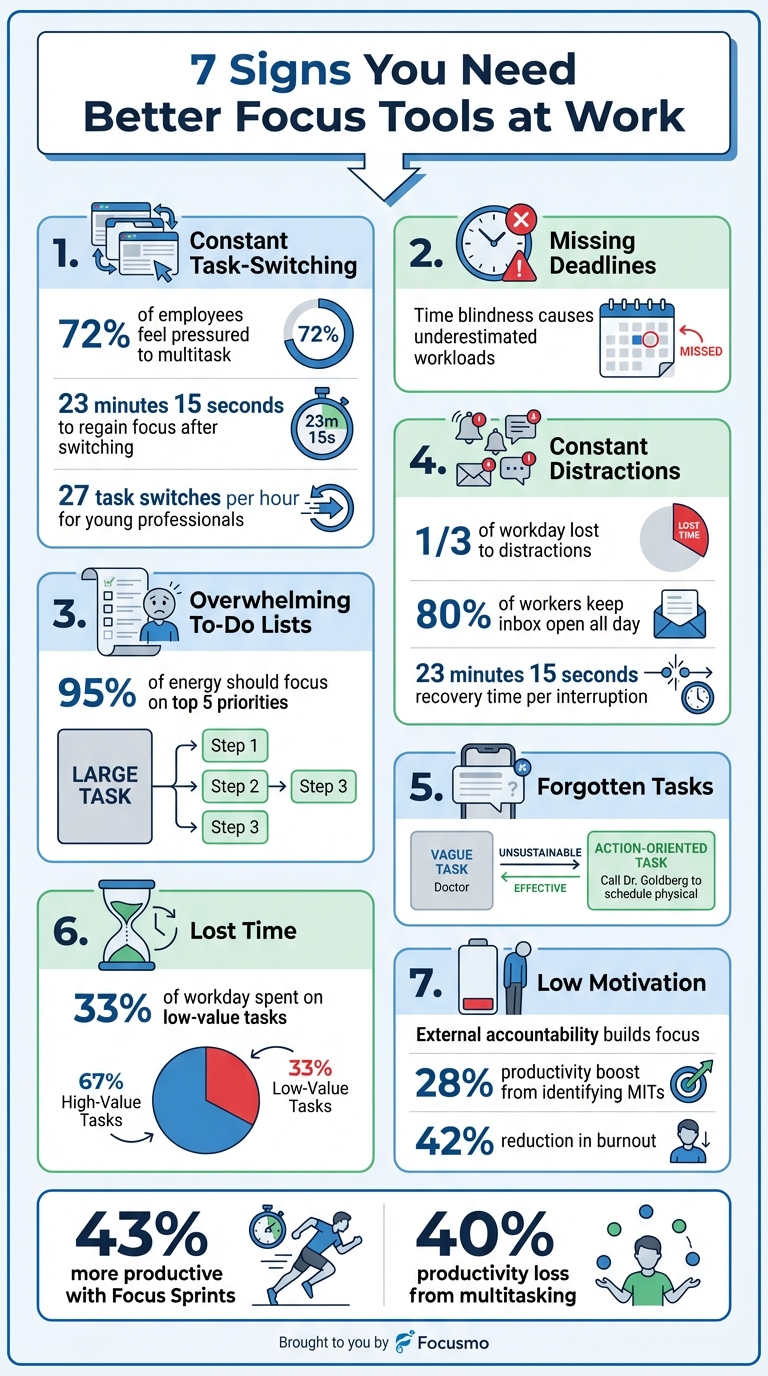
7 Signs You Need Better Focus Tools: Key Productivity Statistics
A Psychiatrist’s Guide: Top 10 ADHD Tools (And How to Use Them)
1. You Switch Between Tasks All Day
If your day feels like a whirlwind of emails, Slack messages, spreadsheets, and project updates, you're not alone. In fact, 72% of employees admit they feel pressured to multitask during the workday. But here's the catch: multitasking isn't what it seems. What you're really doing is rapid task-switching, and that constant shifting takes a toll on your brain's efficiency.
Dr. Sahar Yousef, a cognitive neuroscientist at UC Berkeley, explains it well:
"Multitasking is a myth. What you're really doing is switching between tasks. It's almost always more efficient to focus on one task at a time."
Research supports this. On average, it takes 23 minutes and 15 seconds to regain deep focus after switching tasks. And with young professionals switching their attention about 27 times per hour, a big chunk of the day is spent recovering from interruptions instead of making progress. This constant back-and-forth drains productivity, making it clear that effective task management is essential.
Task Management and Prioritization Features
One major reason for all this task-switching? A lack of clarity about priorities. When everything feels urgent, it's hard to focus. 29% of knowledge workers say they feel overworked because they don’t have clear direction on their tasks and roles. A simple fix? Start each day by identifying your "Most Important Tasks" (MITs) - just 1 to 3 critical priorities. Doing this can boost individual productivity by 28% and reduce burnout by 42%.
Cal Newport, an expert on deep work, puts it perfectly:
"Clarity about what matters provides clarity about what does not."
By consolidating and prioritizing your tasks, you free up mental energy and create space for focused, meaningful work. This approach naturally leads to better time management practices that help you regain control of your day.
Time-Tracking and Scheduling Tools
Time blocking is a powerful way to structure your day and avoid the chaos of constant planning. By dedicating specific blocks of time to one activity, you can ignore distractions guilt-free. Teams that adopt "Focus Sprints" - periods of uninterrupted work without app-switching - report being 43% more productive. Another helpful strategy? Batch your communication into two 30-minute slots each day, one in the morning and one in the afternoon. This keeps you from constantly checking your inbox and losing momentum.
These techniques help you reclaim your time and focus, aligning perfectly with other productivity strategies aimed at creating a more effective workday.
2. You Lose Track of Time and Miss Deadlines
Ever find yourself wondering where the hours went, or rushing frantically to meet a 5:00 PM deadline at 4:45? This common experience, often referred to as "time blindness", highlights the need for better tools and strategies to keep your workday on track.
When time slips away, it often leads to underestimated workloads and missed deadlines. The key to avoiding this? A disciplined approach to scheduling that safeguards your time and commitments.
Time-Tracking and Scheduling Tools
To tackle time blindness, having a structured system for managing your day is essential. Clear scheduling methods not only help you stay organized but also create external accountability.
Time blocking is a particularly effective strategy. By assigning specific time slots on your calendar for each task, you minimize the risk of tasks overlapping or dragging on. For example, if you block out 90 minutes for writing a report before your next meeting, that sense of urgency helps you stay focused and avoid procrastination.
Taking it a step further, time boxing sets strict time limits for completing tasks. This method is especially helpful in curbing perfectionism. By deciding upfront how much time you'll dedicate to a task, you create a natural stopping point. For instance, if you have a hard deadline, like leaving for an appointment, time boxing ensures you finish your work before moving on.
Accountability and Productivity Insights
Time-tracking tools can be game-changers when it comes to staying on top of deadlines. These tools provide a clear, objective view of your progress, helping you avoid those last-minute scrambles. Many also offer dashboards that display task statuses, ownership, and potential blockers, giving you a bird’s-eye view of your workload.
There’s also a psychological boost to consider. As one productivity researcher points out, people thrive on the satisfaction of saying, "I did it". By tracking your completed tasks and identifying patterns in your work habits, you gain a better understanding of how long things actually take. This awareness makes it easier to plan realistically and meet future deadlines.
Incorporating these strategies into your routine can help you reclaim control over your time and navigate even the busiest workdays with confidence.
3. Long To-Do Lists Leave You Stuck
A never-ending list of tasks can feel like standing at the base of a mountain, unsure where to start climbing. Oversized, vague tasks like "Write Report" often lead to paralysis because they feel too big to tackle. Breaking them down into smaller, specific steps - like "Open document", "Write one sentence", or "Draft introduction" - can make the process manageable and even rewarding. Completing these bite-sized steps gives you small dopamine boosts, keeping your motivation alive. As Russell Barkley, PhD, puts it:
"ADHD is not a disorder of knowing what to do. It's a disorder of doing what you know".
Task Management and Prioritization Features
The key to overcoming overwhelm lies in smarter task management. Instead of letting your to-do list spiral out of control, focus on what truly matters. Peter Bregman suggests dedicating 95% of your energy to your top five priorities, ensuring minor tasks don’t derail your attention.
Tools like the Eisenhower Matrix can help you sort tasks into four categories based on urgency and importance. This method makes it easier to spot what requires immediate action, what can wait, and what doesn’t need to be done at all. Another approach is to classify tasks as either "Think Work" (requiring deep focus) or "Action Items" (quick and simple), helping you allocate your energy more effectively throughout the day.
One game-changing strategy is assigning a specific time for each task. Instead of just listing what needs to be done, block out time for each item on your calendar. This approach helps quiet the mental noise caused by the Zeigarnik Effect - the tendency for unfinished tasks to nag at your mind. When your brain knows exactly when something will be handled, it can stop interrupting your current focus with constant reminders.
These techniques not only shrink your to-do list but also create space for you to handle distractions and challenges more effectively throughout your day.
4. Distractions Break Your Focus Time
Distractions are more than just minor annoyances - they can seriously derail your ability to maintain focus. Research shows that every interruption sets you back an average of 23 minutes and 15 seconds before you can fully refocus. Add up these moments, and you could lose nearly a third of your 8-hour workday.
And it’s not just external distractions like email alerts or Slack notifications causing the problem. Often, we’re our own worst enemies. Maybe you check social media "just for a second" or open a new browser tab out of boredom. These self-imposed interruptions are surprisingly common, with younger individuals switching their attention 27 times per hour on average. Each shift not only drains mental energy but also increases the chances of making mistakes.
Distraction-Blocking Capabilities
The key to staying focused? Remove the distractions altogether. Alexis Haselberger, a productivity and time management expert, puts it plainly:
"Studies show that most people lose up to 1/3 of their workday simply to recover from distractions. Many people end up working much longer than a standard 8-hour workday to account for this".
Distraction-blocking tools can be a game-changer. They take the burden off your willpower - which naturally wanes throughout the day - by creating an environment where distractions can’t reach you. For example, silencing notifications, blocking time-wasting websites, and setting strict email-checking windows (like two 30-minute sessions per day) can significantly reduce interruptions. Yet, 80% of knowledge workers keep their inbox or communication apps open all day, practically inviting constant disruptions.
Small adjustments can have a big impact. Activate "Do Not Disturb" mode, use noise-canceling headphones to block out background chatter, or try visual timers like the Pomodoro Technique, which breaks work into focused 25-minute intervals. These strategies help you build momentum and create the conditions needed for deep, uninterrupted work.
sbb-itb-8245ce4
5. You Forget Tasks Even With Reminders
You set a reminder, your phone buzzes, and you think, "I'll get to that in a minute." But before you know it, hours have passed, and the task has completely slipped your mind. This is the downside of relying on a single notification - it's all too easy to dismiss and forget.
The issue gets even trickier when tasks are vague. For example, jotting down "Doctor" on your to-do list doesn't clarify what action you need to take. Are you scheduling an appointment? Following up on test results? Each requires a different approach. Productivity experts suggest using action-oriented task names with specific verbs, like "Call Dr. Goldberg to schedule physical." This simple tweak reduces the mental effort of figuring out what to do and makes it easier to take the first step.
Task Management and Prioritization Features
Using natural language tools can make capturing tasks seamless. For instance, typing "Email boss at 9:00 AM tomorrow" directly schedules the task for you. This eliminates the risk of forgetting before you even have a chance to write it down.
Smart categorization can also make a big difference. Automated lists that organize tasks by due date or priority ensure that your most important items stay front and center. This way, you don’t have to dig through a long list to figure out what needs attention first. By keeping critical tasks visible, you're less likely to overlook them.
Time-Tracking and Scheduling Tools
Persistent reminders can be a game-changer for forgetfulness. Unlike a one-time alert that’s easy to swipe away, some tools send repeated notifications until you either complete the task or actively reschedule it. While it might feel a bit intrusive, this method is highly effective, especially when distractions are constant.
Visual tools like timelines and color-coded schedules can help combat "time blindness", where hours seem to vanish without you noticing. Seeing your day broken into clear blocks makes it easier to stay on track and know when to switch gears. Desktop widgets that show countdowns to upcoming meetings or deadlines provide constant visual nudges, keeping your commitments top of mind.
6. You Don't Know Where Your Time Goes
You start your day at 9:00 AM, and before you know it, it's 3:00 PM, and you're left wondering where all that time went. You've been busy, sure - but what exactly did you achieve? This isn't about laziness; it's about not having a clear picture of how your time and focus are being spent. In fact, desk workers typically spend about 33% of their day on tasks that don't add much value. Without visibility into how your time is divided, it's easy for hours to slip through the cracks.
Often, hidden patterns in your workday go unnoticed. You might think you're dedicating long stretches to important projects, but constant interruptions and switching between tasks can quietly eat away at your productivity.
Time-Tracking and Scheduling Tools
Automatic time-tracking tools can monitor how you use apps, websites, and documents throughout the day. Pair this with time blocking - scheduling specific tasks into dedicated slots - and you'll start to see clear boundaries in your day. This approach not only helps you stick to a plan but also reveals whether your actual work habits match the schedule you set.
Accountability and Productivity Insights
Detailed tracking reports can categorize your day into segments like "Focus", "Personal", or "Distracting". These insights can also highlight your peak performance hours, allowing you to reserve that time for your most demanding tasks. For instance, you might discover you're sharpest between 9:00 AM and 11:00 AM, with a noticeable energy dip later in the afternoon.
"My tracking tool helps me identify not just how I spend my time but also when I'm most likely to do my best work each day."
– Jonathan White, Developer, Airbnb
Tracking your time over the long term can also show whether changes to your routine are actually effective. Whether you're experimenting with the Pomodoro Technique or adjusting your daily schedule, monitoring these shifts removes the guesswork and helps you make smarter decisions. Understanding where your time goes is just the first step - next, it's important to explore how external factors might be influencing your motivation.
7. You Can't Stay Motivated Without External Support
Staying motivated goes beyond just managing tasks or avoiding distractions - it often requires a helping hand from external support systems. If important tasks are piling up despite your best intentions, it might not be a lack of effort but rather your brain needing some outside structure to fill the gaps. This isn’t a personal failing; it’s a sign that external systems can help where internal ones struggle. For individuals with ADHD, this is especially true, as they naturally have lower levels of dopamine - a neurotransmitter that plays a big role in motivation, mood, and focus. That’s why tasks like filing reports or answering emails might not feel rewarding enough to spark action.
Accountability and Productivity Insights
When internal motivation isn’t enough, external accountability can make all the difference. One effective method is body doubling, where you work alongside someone else - whether in person or virtually. This shared presence can keep you grounded and focused, especially during dull or demanding tasks. There’s also a psychological boost in being able to tell an accountability partner, “I got it done.” Over time, this habit builds stronger focus and consistency.
"Accountability builds focus - and, in the long run, creates change - because everyone (particularly someone with ADHD) thrives on being able to say, 'Yep, I did it.'"
– Susan Lasky, M.A., BCC, SCAC
Another way to stay on track is by using progress tracking and reward systems. Tools that feature visual indicators, like star charts or timers, make it easier to see your achievements as they add up. These small, visible wins can be incredibly motivating, turning even minor accomplishments into fuel for continued effort. Together, these external supports create a toolkit that helps balance productivity and focus throughout the day.
How Focusmo Addresses These Problems
Focusmo tackles the common productivity hurdles of task switching, distractions, and poor time management with a suite of practical features:
- Single-task focus system: Employs timeboxing to ensure you stay locked on one task until it's finished.
- Deep Focus mode: Blocks out distractions, keeping your attention where it belongs.
- Automatic time tracking: Monitors your app usage and helps you set achievable deadlines.
- Visual timers and reminders: Provides clear, customizable cues to maintain focus. Notification batching schedules specific blocks of time for emails and messages, addressing the fact that interruptions can cost an average of 23 minutes and 15 seconds to regain focus.
- Task batching and prioritization: Breaks down overwhelming to-do lists into manageable chunks. The productivity analytics dashboard highlights work patterns, such as how administrative tasks might eat into your deep-focus time.
- Floating task visibility window: Keeps your top priority front and center, while progress tracking offers small, visible wins to keep motivation high throughout the day.
These tools are designed to not only streamline your workflow but also boost your productivity in meaningful ways. And with flexible pricing options, Focusmo ensures you can find a plan that aligns with your specific needs.
Pricing That Works for Your Budget
| Plan | Price | Best For | Key Benefits |
|---|---|---|---|
| Free Trial | $0 (7 days) | Testing ADHD-friendly features | Full access to all features before committing |
| Monthly Plan | Contact for pricing | Short-term projects or students | Flexible month-to-month commitment |
| Annual Plan | Contact for pricing | Year-round productivity support | Discounted rate for professionals |
| Lifetime Plan | $150 (one-time) | Long-term users with multiple devices | Covers multiple devices and removes recurring fees |
The Lifetime Plan stands out by eliminating recurring subscription fees, simplifying your financial commitments. It also ensures seamless access across all your devices - whether it's your phone, tablet, or computer - so you can maintain focus without the hassle of switching contexts or juggling payments.
Conclusion
Struggling to stay focused can do more than just slow you down - it can drain your energy and leave you feeling overwhelmed by unfinished tasks. Constantly bouncing between tasks, losing track of time, or forgetting what you started can lead to more stress and less productivity.
Research shows it takes about 23 minutes and 15 seconds to regain focus after an interruption. On top of that, multitasking can reduce productivity by 40%. As productivity expert David Allen wisely points out:
"Much of the stress that people feel doesn't come from having too much to do. It comes from not finishing what they've started".
But these challenges don’t have to rule your day. The right tools can help you take control by blocking distractions, managing your time, and keeping your priorities clear. Whether you’re juggling multiple projects, dealing with ADHD, or simply trying to cut through the noise of constant interruptions, having the right support can make all the difference.
Focusmo offers exactly that. With a 7-day free trial, you can explore features like distraction blocking, single-task focus, and visual timers - all designed to streamline your day. And if you’re ready to commit, their Lifetime Plan is available for just $150, giving you unlimited access with no recurring fees.
If your current methods aren’t working, it’s time to try something new. Start your free trial today and discover how Focusmo can help you reclaim your productivity and take back your day.
FAQs
How can I minimize time wasted by switching between tasks?
Switching between tasks can seriously derail your focus, eating up as much as 40% of your work time. To tackle this, consider grouping similar tasks together into dedicated time blocks and minimizing interruptions during those periods. A popular approach is the 52/17 method: work with intense focus for 52 minutes, then take a 17-minute break to recharge. During those work intervals, turn off notifications, close any tabs you don’t need, and stick to the tools essential for the task at hand.
Another strategy worth trying is the 1-3-5 rule. Each day, aim to complete one big task, three medium ones, and five smaller ones. This method keeps your priorities clear and your workload manageable. Pair this with a “deep work” approach: tidy up your workspace, set clear goals for each time block, and limit email or chat checks to specific times instead of responding instantly. By organizing tasks, working in structured intervals, and cutting out distractions, you can reclaim those lost hours and get more done.
How can I manage time blindness and stay on track at work?
Time blindness, or losing track of how long tasks actually take, can throw a wrench into your productivity. To tackle this, consider using timers - a Pomodoro timer or a simple digital countdown can make the passing of time more tangible. Keeping a clock or even a timeline graphic in your workspace can also help you stay mindful of how time is slipping by. After finishing a task, take a moment for a quick time audit. Did it take longer or shorter than you expected? This practice can sharpen your sense of timing over time.
For bigger projects, break them into smaller, more manageable steps and assign a realistic time estimate to each one. Add a 10–15% buffer to account for any surprises or delays. A calendar with start-and-end alerts, paired with multiple reminders - whether on your phone, computer, or even sticky notes - can keep you on track. Visual aids like color-coded blocks can make deadlines stand out and feel more approachable.
Another helpful strategy is building accountability into your routine. Share your schedule with a coworker or set up brief check-ins to review your progress. Knowing someone else is keeping tabs on your work can give you that extra push to stay focused. By combining tools like timers, thoughtful planning, and a little external accountability, you can turn time blindness into something you can manage effectively.
How can I make my to-do list feel less overwhelming and easier to manage?
To make a long to-do list feel less overwhelming, start by gathering all your tasks in one spot. Whether it’s a digital planner or a task management app, having everything written down helps you clear your mind and see the full scope of what needs to be done.
Once you’ve got your list, focus on what matters most. Identify 2–3 top-priority tasks - those that are either urgent or will have the biggest impact. Break each of these into smaller, bite-sized actions that you can complete in 5–15 minutes. For example, instead of just “write the report,” you could list steps like “draft the introduction” or “collect the necessary data.”
To keep your momentum going, try using a Pomodoro timer. Set it for 25 minutes and dedicate that time to one small task. Afterward, take a 5-minute break. Repeat this cycle, and with each session, check off what you’ve accomplished. Adjust your plan as needed along the way. By breaking things down and staying organized, you’ll feel more in control and make steady progress.