10 Time Management Tips for People with ADHD
10 Time Management Tips for People with ADHD
Managing time with ADHD can feel overwhelming, but the right strategies can make a big difference. This guide outlines practical tips to help you stay focused, meet deadlines, and reduce stress. Here's a quick overview of the key takeaways:
- Use timers: Tools like Focusmo's Pomodoro timer break tasks into manageable chunks.
- Set reminders: Hourly check-ins and alerts help you stay on track and avoid time blindness.
- Break tasks down: Divide big projects into smaller, actionable steps to avoid feeling stuck.
- Block distractions: Limit access to apps and websites that derail your focus.
- Organize tasks: Group responsibilities into categories to simplify your workflow.
- Build routines: Use reminders to create consistent daily habits.
- Track your time: Automatic activity tracking provides insights into how you spend your day.
- Handle quick tasks immediately: Apply the 2-minute rule to prevent small tasks from piling up.
- Prepare for meetings: Use alerts to ensure you're ready and punctual.
- Review your week: Analyze reports to identify patterns and improve your time management.
These strategies are designed to work with the way your brain operates, not against it. Start small - try one or two tips this week - and see what works best for you.
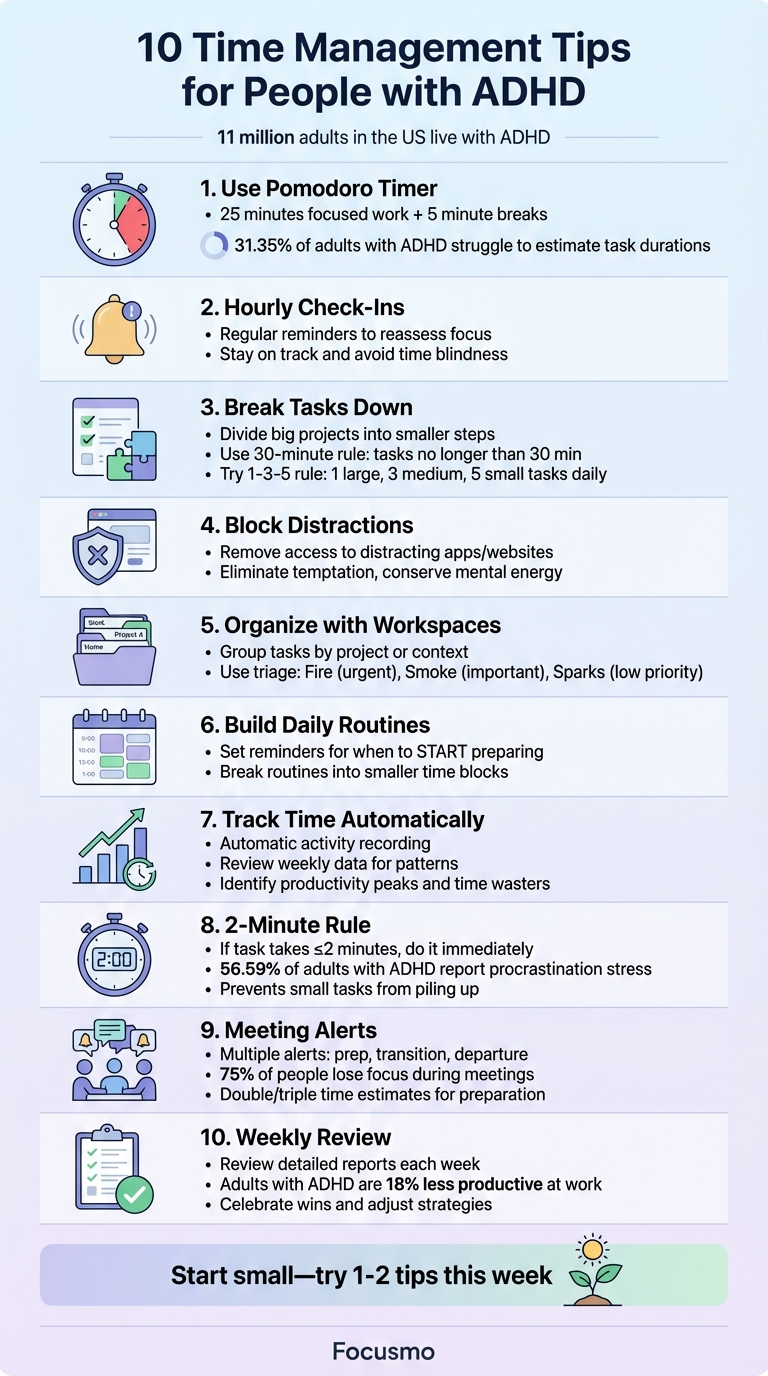
10 Time Management Tips for ADHD: Visual Guide
Low Tech Solutions for ADHD 2: Time Management
1. Use Focusmo's Pomodoro Timer for Focused Work Sessions
Time can feel slippery for ADHD brains, making it tough to track how long tasks take. In fact, 31.35% of adults with ADHD report struggling to estimate task durations accurately. Focusmo's Pomodoro timer helps solve this by turning time into something tangible and manageable.
Here’s the gist: you commit to 25 minutes of focused work, followed by a 5-minute break. Instead of aiming to finish an entire project, you focus on working in short, manageable bursts. This shift in mindset helps reduce the resistance that often leads to procrastination. As Dr. Holly Schiff, a Licensed Clinical Psychologist, puts it:
"Chunking your time makes it easier to accomplish one goal or task and then move onto the next. You also get that sense of accomplishment as well as momentum to keep going."
The breaks aren’t just a bonus - they’re a necessity. Research shows it can take anywhere from 5 to 20 minutes to refocus after an interruption. Those scheduled 5-minute breaks give your brain a chance to recharge, helping you avoid the mental fatigue that comes from working nonstop.
Focusmo also lets you tweak the timer settings to fit your needs. If 25 minutes feels like too much, you can opt for 20-minute sessions instead. Plus, you can enable a "pre-timer" alert that goes off 5 minutes before the session ends, making it easier to transition smoothly without being jolted out of hyperfocus. These small adjustments make it easier to build habits that stick.
Here’s a handy tip: keep a notepad nearby during your work sessions. If a distracting thought pops up, jot it down quickly and get back to your task. This way, you stay focused without losing track of important ideas.
2. Stay on Track with Focusmo's Hourly Check-Ins
For individuals with ADHD, keeping track of time can feel like an uphill battle. It’s easy to lose hours when you're hyper-focused on a task - or even just scrolling through something that grabs your attention.
That’s where Focusmo’s hourly check-ins come in. These reminders act as external accountability markers, giving you a moment to pause and reassess what you’re doing. As expert Russell Barkley highlights, timed interventions can be incredibly effective. These prompts encourage you to ask yourself: Am I still on track, or is it time to pivot? They’re quick, intentional breaks designed to refocus your attention and transition smoothly into actionable strategies.
These check-ins are also great for snapping out of what some describe as an ADHD "trance." Susan, a reader of ADDitude, puts it perfectly:
"A buddy (my housemate) checks on me to make sure I'm on task. I'm usually not, and she breaks the trance that has taken my attention away".
To make the most of these check-ins, try using the Triage Method to categorize your tasks. Label them as Fire (urgent), Smoke (important), or Sparks (low priority). This simple system helps you decide whether to stay the course or switch gears without overthinking.
You can also tailor your check-in reminders to fit your natural productivity patterns. For example, if you’re a night owl, set alerts for after 8:00 PM when you’re most energized. The goal is to establish consistent, well-timed pauses that work with your personal rhythm.
3. Break Tasks into Smaller Steps with Focusmo Task Visibility
Tackling a massive project can feel paralyzing, especially for individuals with ADHD. This isn't about being lazy - it's about the mind struggling to figure out where to start when everything feels equally urgent and overwhelming.
Focusmo's task visibility feature is designed to ease this burden by making the process of breaking down tasks more tangible. Instead of relying on mental notes, you can divide a daunting project into clear, actionable steps, creating a visual plan to follow. As Grace Berman and Carey Werley from The Ross Center explain:
"Large tasks can be overwhelming. Break them into smaller, more manageable steps... This makes tasks seem less daunting and helps you stay motivated".
With Focusmo, you can keep these mini-tasks front and center using tools like the floating island. For example, instead of a vague reminder like "Work on presentation", you can create specific actions such as "Complete slides 1 through 5". This visual system supports those with ADHD by addressing executive dysfunction - challenges with planning and organizing. Every small step completed builds momentum, making the big picture feel less intimidating.
This approach doesn’t just apply to big projects; it’s also useful for structuring daily routines. One effective strategy is the 30-minute rule: break tasks into chunks that take no more than half an hour to complete. For example, instead of writing "pack everything" when preparing for a move, break it down into smaller tasks like "pack kitchen utensils", "box up the closet", and "label boxes." As the ADDA Editorial Team points out:
"A big project like packing up your apartment for a move can feel too overwhelming to start. Instead of leaving it until the day before the truck pulls up, write down every small task involved".
Another helpful tip is to double your time estimates to account for interruptions or time blindness. This extra buffer can make a big difference in staying on track.
For daily planning, try the 1-3-5 rule: focus on 1 large project, 3 medium tasks, and 5 small chores each day. This method keeps your to-do list realistic and prevents the overwhelm that comes from juggling too many priorities at once.
4. Block Distractions with Focusmo's Distraction Blocker
For individuals with ADHD, distractions can be incredibly tempting. Whether it's a social media notification, a breaking news alert, or an open browser tab, staying on task can feel like an uphill battle. As Russell Barkley, Ph.D., puts it:
"ADHD is not a disorder of knowing what to do, it's a disorder of doing what you know - at the right times and places".
Focusmo's Distraction Blocker tackles this challenge head-on by eliminating the option to engage with distractions. Instead of relying solely on willpower, the tool blocks access to websites and apps that commonly pull your attention away. When platforms like Instagram, Twitter, or YouTube are inaccessible, the task at hand becomes the path of least resistance.
This method is effective because it helps conserve mental energy by minimizing decision fatigue. Dr. Stefan Ivantu highlights this concept:
"Structuring your environment to remove distractions eliminates the temptation to procrastinate, making it easier to focus".
To get started, identify your biggest distractions and add them to your block list. You can also silence calls and turn off message notifications to maintain a focused environment during deep work sessions. For even better results, combine this with the Pomodoro timer to work in structured, distraction-free intervals. This setup not only keeps interruptions at bay but also pairs seamlessly with your task management strategies.
5. Organize Tasks with Focusmo's Workspace Management
A cluttered to-do list can leave you feeling stuck, especially if you have ADHD. That overwhelming sense of choice paralysis can sap your energy before you even get started. Focusmo’s workspace management feature tackles this issue by allowing you to group tasks based on projects or contexts - like separating work assignments from personal errands or schoolwork.
By grouping tasks this way, your responsibilities become easier to handle. Instead of facing an endless, chaotic list, you can open a specific workspace, like "Work", and focus only on the tasks that matter most. This approach not only simplifies your workflow but also minimizes decision fatigue, making it easier to stay on track.
To sharpen your focus even further, you can use a triage system within each workspace. Label tasks as "Fire" (urgent), "Smoke" (important), or "Sparks" (low priority). Pair this with a "Must-Do" vs. "Could-Do" matrix to prioritize effectively.
Dr. Holly Schiff, a licensed clinical psychologist, highlights the importance of prioritization:
"Prioritizing tasks can help you manage your time better. Make sure your high-priority tasks are first, followed by tasks that you can work on later".
sbb-itb-8245ce4
6. Build Daily Routines with Focusmo Reminders
For those with ADHD, keeping up with everyday tasks can feel like trying to hold water in your hands. You know what needs to get done, but the leap from knowing to doing often feels overwhelming. This struggle comes from how the ADHD brain processes timing and task execution - understanding what to do doesn’t always mean it happens when it should.
That’s where Focusmo’s reminder system steps in. By externalizing time, it ensures you’re notified well in advance of tasks or appointments. Instead of depending on your internal sense of time (which may not always be reliable), these reminders make key moments clear and actionable.
The trick is to set reminders for when you need to start preparing, not just for the event itself. For instance, if you have a meeting at 9:00 AM, schedule an alert for 8:30 AM to begin getting ready. For more complex routines, you can break it down into smaller steps: 7:00 AM wake-up, 7:30 AM breakfast, and 8:00 AM out the door. This kind of planning helps you sidestep the “too late” moment that often disrupts ADHD schedules. With Focusmo, these reminders flow into customizable notifications, giving your day a structured rhythm.
Tailor Focusmo notifications to anchor essential tasks like taking medication, reviewing your planner, or starting your nighttime wind-down. Recurring alerts take the pressure off remembering every detail, easing decision fatigue and helping you stay on track. To keep things manageable, focus on only the most important reminders. This way, you avoid notification overload and ensure that the alerts you do receive remain impactful. When combined with other Focusmo features, these reminders help you craft a smooth, organized daily routine.
7. Track Your Time Automatically with Focusmo's Activity Insights
Manually tracking time can be a struggle for individuals with ADHD. It often relies on executive functions that are already under strain, adding an extra layer of mental effort that’s hard to sustain.
That’s where Focusmo's Activity Insights comes in. This feature works quietly in the background, automatically recording your activity across apps and websites. The result? A detailed, objective view of how you’re actually spending your time.
For those with ADHD, time blindness can make it difficult to gauge how long tasks take or where the day goes. But having clear, unbiased data can help correct those misjudgments. Focusmo transforms this data into practical insights, helping you make smarter choices about your time.
Here’s how you can use it effectively:
- Spot patterns in your productivity: Review your weekly data to find out when you’re most productive. Plan your toughest tasks for these high-energy periods.
- Identify distractions: Notice which apps or websites are pulling your focus without helping you achieve your goals.
- Compare plans vs. reality: Match your planned time blocks with the recorded data to uncover where time is slipping away.
Set aside 15 minutes each Sunday to review your activity data. Use this time to reflect on what worked, adjust your priorities, and tweak your environment to better support your goals. It’s a simple habit that can lead to big improvements in how you manage your time.
8. Start Small with Focusmo's 2-Minute Rule Integration
The 2-minute rule is straightforward: if a task takes two minutes or less, handle it right away. For individuals with ADHD, this method helps prevent small tasks from piling up and overwhelming your mental space.
"All those things we say we will do later, which don't get done, take up too much 'bandwidth' in our brain."
– Sandy Maynard, M.S., Owner, Catalytic Coaching
Focusmo makes it easier to identify these quick tasks - like labeling a contact, replying to a short message, or filing a document. Clearing them out reduces mental clutter and creates smoother transitions to bigger projects.
Tackling these tiny tasks builds momentum and helps break through ADHD-related paralysis. Each small accomplishment becomes a stepping stone toward larger goals. Interestingly, 56.59% of adults with ADHD report that procrastination on important tasks is a major source of stress. By integrating quick actions into your routine, you can chip away at that stress while staying on top of your responsibilities.
Focusmo’s task visibility is perfect for spotting these quick wins during natural pauses in your day - like waiting for your coffee to brew or in between meetings. Pairing the 2-minute rule with a visual timer ensures these tasks stay short and don’t spiral into distractions. It’s a simple way to prove to yourself that your workload is manageable, helping to break the cycle of avoidance.
9. Never Miss Meetings with Focusmo Meeting Alerts
For individuals with ADHD, the concept of time can feel elusive. Time blindness - the difficulty in perceiving the passage of time and estimating how long tasks take - makes punctuality a real challenge. It's not just about remembering a meeting; it's about having the right tools to act on that knowledge at the right moment. Psychologist Ari Tuckman explains it perfectly:
"By the time you feel it, it's too late".
This is where Focusmo steps in. Its meeting alerts are designed to guide you through every stage, from wrapping up your current task to preparing and leaving on time. These reminders act as external prompts, helping you transition smoothly and avoid the jarring rush that often comes with last-minute realizations. Considering that nearly 75% of people lose focus during meetings, this structured system can be a game-changer.
One practical tip is to build extra time into your schedule for preparation, travel, and task-switching. Many ADHD experts suggest doubling or even tripling your initial time estimates to account for underestimations. When using Focusmo, you can incorporate these "hidden" time costs and set your first alert to go off at the start of your prep phase.
Focusmo also lets you fine-tune your alerts so that only the most important reminders get through. Choose between sound, visual cues, or even vibrations - many users find vibrating notifications particularly effective for breaking through hyperfocus. By automating these reminders, you reduce the mental effort of constant clock-watching and stay on track without feeling overwhelmed.
10. Review Your Week with Focusmo's Detailed Reports
Focusmo's detailed reports are a game-changer for understanding how you spend your time. For individuals with ADHD, keeping track of tasks and productivity can be tricky, but these reports provide a clear, objective snapshot of your week.
One of the key benefits? Spotting those sneaky "time eaters" - like endless social media scrolling or long, unproductive transitions - that quietly drain your hours. The reports also let you compare how long you think tasks will take versus how long they actually take. This can help bridge the gap between your plans and reality. Therapist Keath Low, MA, explains:
"Hone your time sense by practicing. Start by estimating how long tasks will take... With a vigilant practice of guessing and recording the actual elapsed time, the gap between your estimated and actual time will narrow".
The data also highlights your peak focus periods, so you can schedule challenging tasks when your energy is at its highest and save routine work for when you're feeling less motivated. Since adults with ADHD are often 18% less productive at work compared to their peers without ADHD, recognizing and working with these natural patterns can make a noticeable difference.
To get the most out of these insights, set aside time each week - like Friday afternoon or Sunday evening - to review your reports. Celebrate your wins alongside identifying areas for improvement. This "What Went Well" approach not only offers a dopamine boost but also builds momentum for the week ahead. As Dr. Ari Tuckman wisely points out:
"Success starts with awareness, but requires intention".
Take what you've learned and use it to tweak your strategies for the upcoming week.
Conclusion
Managing time effectively with ADHD means working with, not against, the way your brain is wired. Tools designed specifically for ADHD, like Focusmo, can help by externalizing time, creating structure, and easing the mental load that makes everyday tasks feel daunting.
There’s no one-size-fits-all approach here. What keeps one person on track might not resonate with someone else. Maybe a Pomodoro timer helps you power through tough projects, or regular hourly check-ins keep you from getting lost in distractions. The goal is to experiment and find the mix of strategies that works for you. This trial-and-error process is essential for creating a productivity system tailored to your unique needs.
With around 11 million adults in the United States living with ADHD, finding effective strategies is crucial, whether you're a student balancing assignments or a professional managing a packed schedule. Combining ADHD-focused tools with proven methods can bridge the gap between good intentions and actionable results.
Start small - try just one or two tips for a week, and let Focusmo’s detailed reports show you what’s working. Remember, building new habits is about progress, not perfection. Ready to take charge of your time? Download Focusmo today and see which strategies click for you.
FAQs
How does Focusmo's Pomodoro timer support time management for ADHD?
Focusmo's Pomodoro timer is a game-changer for individuals with ADHD. It breaks work into 25-minute focus sessions, each followed by a short break. This simple yet effective structure helps create a sense of urgency, minimizes distractions, and makes even daunting tasks feel approachable.
By promoting consistency and helping to avoid burnout, the Pomodoro technique is an excellent way to boost focus and complete tasks more effectively. It's thoughtfully designed to address the specific challenges faced by people with ADHD, making staying productive a lot more manageable.
How can people with ADHD stay focused and avoid distractions?
Staying focused with ADHD often starts by shaping your environment to cut down on distractions. One simple step is to clear your workspace of anything unrelated to the task you're working on. A tidy, organized space reduces visual clutter, making it easier to concentrate. You can also place a visible reminder - like a sticky note with your main goal for the session - where you can see it. This little nudge can help you stay on track and avoid veering off course.
Another effective approach is using time-blocking strategies. Break your day into manageable work sessions and plan tasks in a physical planner or digital calendar. Pair this with a timer - like the Pomodoro technique - to create clear start and stop points. This method not only adds structure to your day but also keeps your brain engaged, reducing the temptation to get distracted.
Lastly, try to focus on just one or two priorities at a time. Narrowing your to-do list for each work period can keep you from feeling overwhelmed. By zeroing in on fewer tasks, you can give your full attention to what truly needs to get done.
How does reviewing weekly reports help with time management for ADHD?
Reviewing weekly reports gives you a clear snapshot of how you've spent your time. This can be especially useful for ADHD brains, which often struggle with accurately judging how long tasks take or spotting patterns in behavior. Taking time to reflect on the past week lets you pinpoint what’s going well - like successful time-blocking techniques - and what’s getting in the way, such as repeated distractions or overloading your to-do list. With this information, you can tweak your schedule, set achievable goals, and focus on what truly demands your attention.
It also builds accountability. Writing down what you accomplished, what fell through the cracks, and what’s coming up transforms vague intentions into solid commitments. This makes it much easier to stay on course. Plus, regular reviews lighten your mental load, ease worries about forgetting important details, and help you break down big projects into smaller, more manageable tasks. These are all essential strategies for boosting productivity and managing time effectively with ADHD.